Saturday, 9 May 2015

Day 2 The Day We Left Madrid

Day 2 – The Day we Left Madrid

After a few days in the Spanish capital of Madrid we were excited to be leaving for the Spanish Countryside.

 To do that we had to meet our Spanish Bird Guide [of British descent] Steve West and I had to pick up a van from the Madrid airport. Both of these elements were achieved early in the day. I met Steve, who had driven down from near Barcelona the previous day in a Nissan Van fully equipped with a dead Chaffinch in the radiator grill, while he was in the midst of delicate car rental negotiations. Soon, well only half an hour after the car rental business had promised the vehicle, all was resolved and we were on our way. Steve, despite not having driven an automatic car for years, was driving an automatic Mercedes van while I, who had not driven a manual for years, was driving a manual Nissan Van. Obviously my left hand kept looking instinctively for the invisible gear stick while my right hand, that had never had the gear-changing pleasure had to be pressed into action.  Despite that minor inconvenience my fourteen months driving experience in North America kicked in and I quickly felt back at home on the right side of the road – even in a manual.

Steve and I picked up the group from the Travelodge and were soon on our way circling the city from the east to the south before heading west towards Extramadura.

First stop, after a couple of hours, was lunch at a service station. No bacteria filled Aussie hot box here but our first Tapas; olives, fresh bread, chicken, pork, rabbit, omelette, calamari washed down with café con leche y coke cola. It was mwee bien [bloody brilliant] or as Russ put it, ‘a ripper’. 
Crested Lark
Our first birding stop was a nearby wetland that had our first Swamphen, Coot, Gadwall, Little Bittern, Grey and Purple Herons on or near the water while Barn and Red-rumped Swallows plus a flotilla of Sand Martins sped around. Raptors were everywhere; Eurasian Griffon Vultures, Marsh and Montague’s Harriers, Black and Red Kites, Booted Eagle plus four Lesser Kestrels flew over us. White Storks were conspicuous while, closer to the ground Crested Lark and Zitting Cisticolas gave us something to look at while Cetti’s Warbler and various Reed Warblers sang invisibly.
Distant Short toed Eagle


Lizard spp?
Lizard spp 2?
Melodious Warbler

Melodious Warbler

Nightingale

Nightingale in song


Savi’s Warbler sang – if that is the correct word as their song is an insect like trill - but refused to show well. I’m sure we got very distant views of this bird on The Stick but they were unconvincing. More convincing was our first Kingfisher – The Kingfisher – as in Europe there is only the one.

Driving and raptors continued; Black Vulture, Short-toed Eagle and, when we stopped, Bonelli’s Eagle. This stop yielded Nightingales, Nightingales and more Nightingales plus warblers; Melodious, Sardinian but we missed an Orphean that had been singing also. Woodchat Shrike, Crag Martin, White Wagtail were also seen at this ‘Warbler Alley’. Two lizard species were recorded here also.
Warbler Alley
Warbler Alley
Bucolic Scene
Before calling it a day we had one last stop for Thekla Lark, Corn Bunting and yet another warbler, Dartford Warbler. I had missed Dartford Warbler in the UK, over twenty years previously, and was delighted to get good views of this bird among this Spanish vegetation, rich as it was with beautiful wild Lavender.
Corn Bunting
Dartford Warbler
Dartford Warbler
Some cool birds encountered enroute included Bee-eaters, Hoopoe, the endemic Iberian Magpie, Jay [that I worked out late in the evening after it flew past my windscreen earlier in the day], and the impressive Egyptian Vulture.

Finally we were treated to an excellent three course meal with local red wine at our hotel. All in all a bloody great day! 


Oh and while we were eating we could watch tits outside the dining room; Blue tits had taken up residence at a nest box. Let me repeat; All in all a bloody great day!  

Thursday, 7 May 2015

First [real] Day in Spain 8 May

Today everybody met for the first time on tour. Jan England had failed to arrive by bedtime last night so currently I am optimistically expecting that she has arrived! Stop Press - Jan has arrived! Apparently there was a fire at the Rome airport which slowed all air traffic. So she is [ no doubt] tired but with us.

Today the plan is to return to our local patch; Quinta de la Molinas. And we need to try to net every species that we have seen thus far and hopefully improve on it. Ok - the results?  A successful mornng with many species seen including a few new ones. The new species included Common Crossbill and Turtledove. Other highlights included a brief fly by of a Green / Iberian Woodpecker. All four Tits; Blue, Long-tailed, Coal and Great. First records of Monk Parakeet on 'our' local patch. Good diversity of Pigeons; Wood, Rock, Stock, Collared, Turtle. Great views of Blackcap. Abundant Serin and Tree Sparrows. Magpies common with Common Swifts, House Martins and the occasional Barn Swallow overhead. Greenfinch and Goldfinches seen regularly. Both specials - Spotless Starling and Short-toed Treecreeper seen well. The main dips? A flycatcher free morning.

Another bonus was views of the Black Redstart near our hotel. Strangely the hotel does not even bother to advertise that it has a Black Redstart near its property - wierd!

Pictured below is a great pair of tits because you cannot have too many tit jokes.
Great Tit in full song

Long-tailed Tit
 33. [Eurasian] Turtledove
 34. Common Crossbill

This afternoon we visited the central area of Madrid for an organised private tour and it was surprisingly good. Madrid is a good product for a historical and cultural tour and we got a good dose of Spanish history generally and Madrid's specifically.

First stop, perhaps not unexpectedly, was the bull fighting stadium. Today, apparently, was the first day in the Spring bull fighting calendar and so it is an exciting time for all bull fight watching affeciendos. While I love rump steak far more than the average vegetarian I'm not totally sure I approve of bull fighting as the odds are oh-so-slightly tilted against old ol toro. I asked our guide, Maria, what happened if the bull was a very good fighter; so good in fact that it killed the matador? She replied simply that that would mean that the bull would be killed. Given that that was the original aim of the game that seemed slightly unsporting. It seems if the matador survives and he [for there are very few shes] wants to reward the bull for a stand up fight the bull can go free, have a herd of cows to himself and live in a kind of bovine heaven - much like the promise given to suicide bombing fanatics [I should be clear here I am not saying that suicide bombers are promised a herd of cows in heaven]

Anyway Bull Fighting is still an important part of Spanish culture across the country except around the greater Barcelona area where the whining Greens, according to Maria, had it banned.

Las Ventes
From Wikipedia - Madrid hosts the largest plaza de toros (bullring) in Spain, Las Ventas, established in 1929. Las Ventas is considered by many to be the world centre of bullfighting and has a seating capacity of almost 25,000. Madrid's bullfighting season begins in March and ends in October. Bullfights are held every day during the festivities of San Isidro (Madrid's patron saint) from mid May to early June, and every Sunday, and public holiday, the rest of the season. The style of the plaza is Neo-Mudéjar. Las Ventas also hosts music concerts and other events outside of the bullfighting season.

Bulls on the side of a wall - about the only safe place for them

From 1913 to 1920, the national passion (bullfighting) gained such an important status that Madrid's former main bullring in Carretera de Aragon was not big enough. It was José Gómez Ortega "Joselito" who declared that a new "monumental" bullring had to be built, to open this part of Spain's heritage and culture to the whole city of Madrid. His friend the architect José Espeliú began to work on the project.

A family called Jardón donated the land to the Madrid Provincial Council, provided that they could run the arena for fifty years. The deputation accepted the proposal on November 12, 1920. On March 19, 1922, in the exact center of the prospective arena, the first stone was placed. The construction of the bullring would cost 12 million pesetas (4.5 million over budget), and it would replace the old bullring, dating from 1874.

"Las Ventas" was finished in 1929 and two years later, June 17, 1931, a charity bullfight was held with a full capacity crowd to inaugurate it. 

 Bullfighting stopped during the Spanish Civil War and did not resume until May 1939.
Strange people
city street scene

monument celebrating the writer, Cervantes

Cervante's characters - Don Quixote and Sancho Panza

a spacious Madrid urinal

King's Palace

a city nude

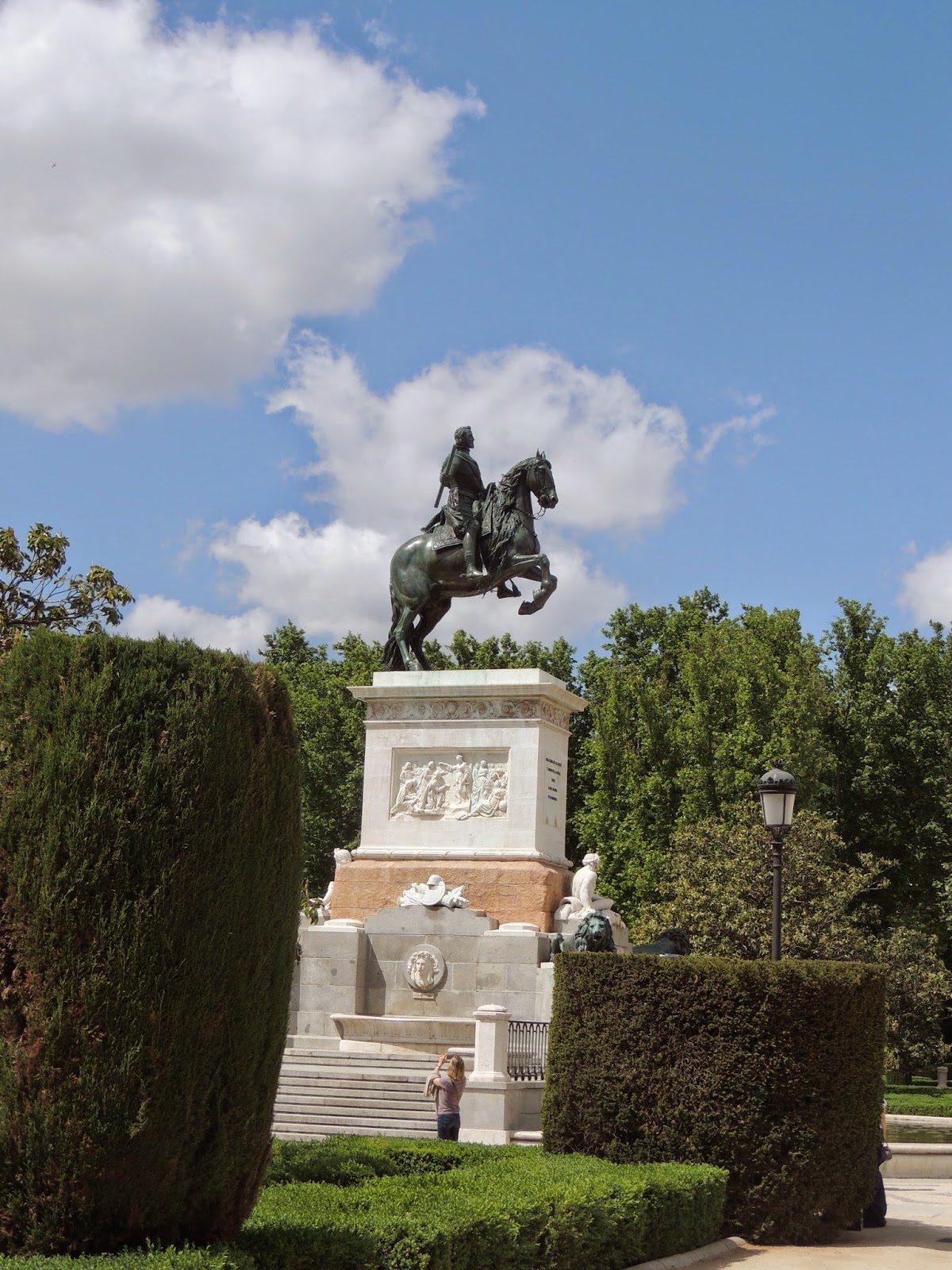
Philip 1V

Madrid Opera House


Very little medieval architecture is preserved in Madrid, mostly in the Almendra central, including the San Nicolás and San Pedro el Viejo church towers, the church of St. Jerome, and the Bishop's Chapel. Nor has Madrid retained much Renaissance architecture, other than the Bridge of Segovia and the Convent of Las Descalzas Reales.


Canalejas Square

Callao Metro Station
Many of the historic buildings of Madrid date from the Spanish Golden Age which coincided with the Habsburgs reign (1516–1700).[citation needed] Philip II moved his court to Madrid in 1561 and transformed the town into a capital city.[67] These reforms were embodied in the Plaza Mayor, characterized by its symmetry and austerity, as well as the new Alcázar, which would become the second most impressive royal palace of the kingdom.[citation needed] The material used during the Hapsburg era was mostly brick, and the humble façades contrast with the elaborate interiors. Notable buildings include the Prison of the Court, the Palace of the Councils, the Royal Convent of La Encarnación, and the Buen Retiro Palace. The Imperial College church model dome was imitated in all Spain. Pedro de Ribera introduced Churrigueresque architecture to Madrid; the Cuartel del Conde-Duque, the church of Montserrat, and the Bridge of Toledo are among the best examples.

The reign of the Bourbons during the eighteenth century marked a new era in the city. Philip V tried to complete King Philip II's vision of urbanization of Madrid. Philip V built a palace in line with French taste, and other buildings such as St. Michael's Basilica and the Church of Santa Bárbara. King Charles III beautified the city and endeavoured to convert Madrid into one of the great European capitals. He pushed forward the construction of the Prado Museum (originally intended as a Natural Science Museum), the Puerta de Alcalá, the Royal Observatory, the Basilica of San Francisco el Grande, the Casa de Correos in Puerta del Sol, the Real Casa de la Aduana and the General Hospital (now houses the Reina Sofia Museum and Royal Conservatory of Music). The Paseo del Prado, surrounded by gardens and decorated with neoclassical statues, is an example of urban planning. The Duke of Berwick ordered the construction of the Liria Palace.


The Gran Vía has styles ranging from Vienna Secession, Plateresque, Neo-Mudéjar, and Art Deco.

Gran Via Street
During the early 19th century, the Peninsular War, the loss of colonies in the Americas, and continuing coups limited the city's architectural development (Royal Theatre, the National Library of Spain, the Palace of the Senate and the Congress). The Segovia Viaduct linked the Royal Alcázar to the southern part of town.

From the mid 19th century until the Civil War, Madrid modernized and built new neighbourhoods and monuments. The expansion of Madrid developed under the Plan Castro, resulting in the neighborhoods of Salamanca, Argüelles and Chamberí. Arturo Soria conceived the linear city and built the first few kilometers of the road that bears his name, which embodies the idea. The Gran Vía was built using different styles that evolved over time: French style, eclectic, art deco, and expressionist. Antonio Palacios built a series of buildings inspired by the Viennese Secession, such as the Palace of Communication, the Fine Arts Circle of Madrid (Círculo de Bellas Artes) and the Río de La Plata Bank (Instituto Cervantes). Other notable buildings include the Bank of Spain, the neo-Gothic Almudena Cathedral, Atocha Station, and the Catalan art-nouveau Palace of Longoria. Las Ventas Bullring was built, as the Market of San Miguel (Cast-Iron style).

Gate of Europe, built during the 1990s.
The Civil War severely damaged the city. Subsequently, the old town and the Ensanche were destroyed, and numerous blocks of flats were built. Examples of post-war architecture include the Spanish Air Force headquarters, and the skyscrapers of Plaza de España, at the time (the 1950s) the highest in Europe.[citation needed]

With the advent of Spanish economic development, skyscrapers appeared in the late 20th century in the city, such as Torre Picasso, Torres Blancas and Torre BBVA, and the Gate of Europe. During the decade of the 2000s, the four tallest skyscrapers in Spain were built,[citation needed] and together form the Cuatro Torres Business Area. Madrid-Barajas Airport Terminal 4 was inaugurated in 2006 and won several architectural awards. Terminal 4 is one of the world's largest terminal areas,[citation needed] and features glass panes and domes in the roof which allow natural light to pass through.


First Days in Spain – 6 & 7 May 2015.

Tree Sparrow in a ....tree
First Day in Spain – 6 May.

The European birding adventure begins…. With long, long travel; Mapleton to Brisbane by car, Brisbane to Hong Kong flight, five hours in Hong Kong airport, 12 hours flight from Hong Kong to London, 2 hour flight to Madrid Spain. Very little sleep in that time period.

Birds enroute? Very few. Crested Myna was the only species seen from the Hong Kong Airport. Basically nothing identifiable from London.

From our hotel we went for a brief walk through the streets to a nearby park and with a few fly by species began our Spanish birding experience with 18 species – three of which were lifers for me.
Enroute we saw Common Swifts, a single Barn Swallow, House Sparrows and found several nests of House Martins, high under the eaves of the roofs of flats.
House Martin
House Martins

The park was named Quinta de Los Molinos; and it seemed to be created around an old grove of almond trees. It was well wooded around the lines of nut trees and there were many plant species including, annoyingly enough gum trees! It was a popular park with walkers, joggers and the occasionally pretty girl perched reading under a tree with her bicycle sprawled next to her.

Eurasian Wood dove
Greenfinch

Speaking of girls we saw several Tits; Blue, Coal and Long-tailed. And then lifers; Serin, Short-toed Tree-creeper, and Spotless Starling. Other species included Chaffinch, Magpies etc.
Spotless Starling [photo by Vincent Lee]
The total for day #1 - 18spp

1. Magpie
Blue Tit
2. Collared Dove
3. Wood Dove
4. Rock Dove
5. Common Swift
6. Barn Swallow
7. House Martin
8. Serin [Lifer!]
9. Short toed Treecreeper [Lifer]
10. Spotless Starling [Lifer]
11. Blue Tit
12. Coal Tit
13. Long tailed Tit
14. House Sparrow
15. Tree Sparrow
16. Greenfinch
17. Blackbird
18. Chaffinch
Coal Tit
Very sad to say we opted for fast food on our first night as we could not stay awake for the 8pm opening time for the dining room.
Day 2 in Spain saw us add quickly to our list; scoring a Black Redstart behind our hotel. It was a pretty good bird to begin the day in the cool of a ten degree morning.

19 Black Redstart

Robin
Lacking any better plan we went back to the park of the day before and added a few more species; Great Tit, Blackcap [a warbler], Pied and Spotted Flycatcher, Stock Dove and Robin! We saw every species from the day before save the Long tailed Tit. So all in all a successful morning’s birding!

20  Great Tit
Blackcap
21  Blackcap
22 Robin
23 Pied Flycatcher
24 Stock Dove
25 Spotted Flycatcher

Not a Rock but a Stock Dove


In the afternoon we boarded taxis and travelled to Parque de Juan Carlos 1. This is a vast park land with many sports facilities and artificial waters, walkways and large sculptures. It was ok but as it was so open and shade-less birding was quite uncomfortable. But, hey, it’s Spain! We got great views of Common Swifts, Barn Swallows and House Martins. Our first Mallards and Moorhens were observed on the waters, which were also densely packed with Carp from Asia and turtles from North America. White wagtail was seen soon after June Harris expressed her surprize at us not yet seeing a wagtail. To our surprise we soon saw parrots flying around – they turned out to be Monk Parakeets and they were common.
Monk Parakeets [or Quakers]

26 Mallard
27 White Wagtail
White Wagtail
28 Common Moorhen
29 Monk Parakeet

Attempting to get out of the sun we aimed for a huge area of vegetation which we soon discovered was a botanical garden. Sadly we very slowly discovered that it was impossible to enter – by this time we had walked the entire distance around the park. I saw a Green Woodpecker well – so maybe it was a lifer if the Iberian sub species is split…. I’ll have to check it out. We also saw, what was most likely, Carrion Crow and some saw a Jackdaw.

30 Green [Iberian] Woodpecker
31 Jackdaw
32 Carrion Crow

Oh I left out a species identified by photo as it flew over the Quinta de los Molinas – a Black Kite.

The wide avenues of Quinta de la Molinas


32. Black Kite
a poor shot of a nice bird and a lifer - Serin
All photos by Ken Cross unless attributed.